
Artificial intelligence is a broad name for systems that perform tasks we associate with human intelligence: recognizing images and speech, working with language, finding patterns, making predictions, and choosing actions.
Today, however, “AI” often refers to something more specific: generative models such as ChatGPT, Claude, Gemini, and systems that create text, code, images, audio, or video.
It helps to avoid two extremes from the start. Modern AI is not a digital person that understands the world exactly as we do. But “it is just autocomplete” is no longer a useful explanation either. A language model does predict what comes next, but it does so using complex internal representations of language, objects, relationships, and common ways of solving problems.
AI, machine learning, and neural networks are not the same thing
These concepts sit inside one another:
- Artificial intelligence is the broad field of systems performing intelligent tasks.
- Machine learning is an approach in which a system learns rules from data instead of having every rule written by hand.
- Neural networks are one family of machine-learning models.
- Large language models, or LLMs, are neural networks trained to work with language and other sequential data.
Not every AI system is a language model. Store recommendations, bank fraud detection, face recognition, and demand forecasting also belong to AI, even when they generate no text at all.
A simplified view of how a language model works
Text is divided into small units called tokens. The model receives a sequence of tokens and estimates which token should come next. Then the process repeats.
Before people can use it, a model goes through several stages:
- Pre-training. The model studies a huge amount of data and learns recurring patterns in language, code, and the world described by them.
- Post-training. It is trained to follow instructions, respect formats, and provide more useful responses.
- Inference. A user submits a request, and the trained model constructs an answer at runtime.
The model is not retrieving a finished reply from a hidden database. It generates the response again each time. This is why the same request can produce slightly different results — and why a confident tone does not guarantee factual accuracy.
Why the result can look like reasoning
During training, a model learns more than isolated phrases. It compresses recurring structures: relationships between concepts, patterns of argument, software structures, writing styles, and sequences of actions.
Several other capabilities make the result stronger:
- training at a very large scale;
- instruction following;
- the ability to retain conversational context;
- external tools such as search, terminals, browsers, databases, and APIs;
- additional computation before answering in reasoning models.
As a result, a model can break down a task, propose a plan, write code, and verify part of its own work. This can function like reasoning, but it does not make the system infallible or prove that it has human consciousness.
What a model knows — and what it does not
Training leaves statistically learned patterns inside the model’s parameters. They are not an exact encyclopedia or an archive of the original documents.
This creates several limitations:
- knowledge may be outdated;
- rare facts and exact numbers may be distorted;
- when information is missing, the model can invent a plausible answer;
- a long context window does not mean every detail will be used equally well;
- the model cannot see a current website, codebase, or database unless it is given the appropriate tool.
These errors are usually called hallucinations. They are not a random defect in one chatbot; they follow from the generative nature of the model itself.
Where AI is genuinely useful
AI is strongest when its output can be checked or refined quickly:
- explaining a difficult subject at the right level;
- collecting and structuring a large body of material;
- suggesting alternatives for copy, interfaces, or architecture;
- classifying and transforming data;
- writing or modifying code in a real project;
- finding inconsistencies, errors, and missing cases;
- automating a repeatable intellectual process;
- building a prototype and testing a hypothesis quickly.
Its main value is not that it “knows everything.” It is the inexpensive loop of form a hypothesis → produce a result → verify → refine.
Where AI creates the illusion of productivity
AI can produce convincing-looking output extremely quickly. That makes it easy to confuse generation speed with problem-solving speed.
You can generate dozens of pages or thousands of lines of code in an evening without getting any closer to a working product. If nobody has defined the goal, quality criteria, and verification method, the model simply accelerates movement in an arbitrary direction.
Blind trust is especially dangerous in medicine, law, finance, security, exact sourcing, and changes to production systems.
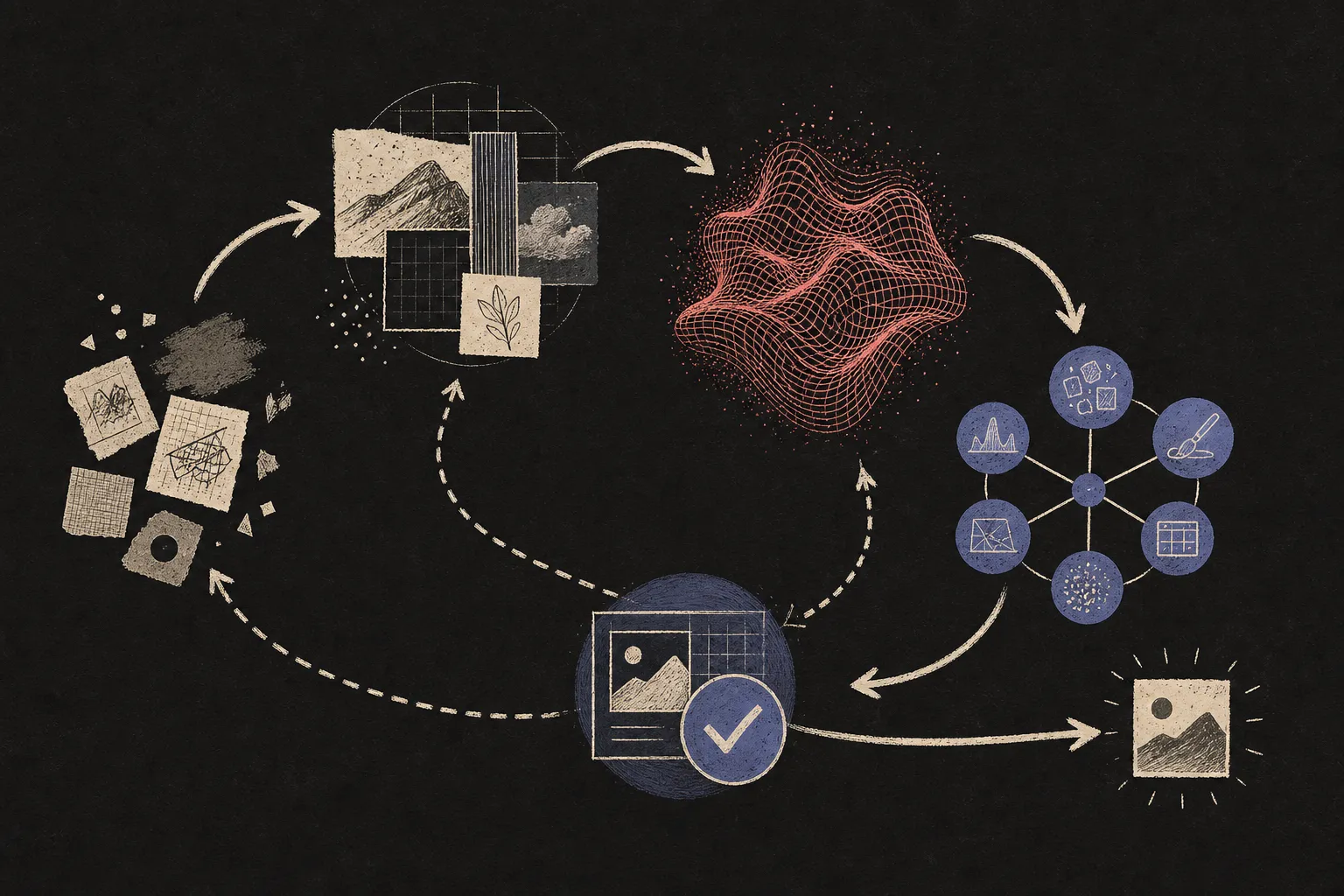
Useful output emerges not at the generation stage, but after verification and another iteration.
A practical way to work with AI
Good results rarely come from one “perfect prompt.” They come from a process:
- Define the task. What exactly should be different when the work is complete?
- Provide context. Files, constraints, audience, examples, and previous decisions.
- Set acceptance criteria. How will a finished result differ from a plausible draft?
- Connect tools. Search for current facts, a codebase for development, or a calculator for exact arithmetic.
- Verify the result. Use tests, sources, measurements, or human review.
- Keep human responsibility. A model can support a decision, but it does not bear the consequences.
When a model can inspect its environment, use tools, complete multiple steps, and verify the result, it is usually described as an AI agent.
The main idea
Modern AI is neither an oracle nor an ordinary search engine. It is a probabilistic tool for working with knowledge, language, and actions.
It is especially powerful when paired with a person who understands the goal, supplies the right context, and knows how to verify the output. It is weakest when a polished answer is treated as automatically true.
The most important AI skill is therefore not writing magical prompts. It is designing a process in which the model’s abilities create a real result and its mistakes are discovered before they become a problem.